

Most villa gardens in Dubai get planned in the wrong order: plants first, shade and water later. The ideas below start from the problems owners actually describe to us, such as a patio too hot to sit on at 4pm, neighbours who can see into the pool, or a plot too small for anything. Each one says where it works and what it costs you in upkeep or compromise.
Prices are left out on purpose. For numbers, see our guide to what landscaping costs in Dubai.
If the garden is too hot to use
1. Put a pergola where the afternoon sun lands
A pergola is the quickest way to make a seating area usable from May to October. Work out where the sun sits from about 2pm, because that is when a west-facing patio is at its worst, and put the roof over that spot instead of centring it on the house wall. A solid or louvred roof gives real shade. Slatted timber gives patchy shade that moves through the day, which some owners like and others find fiddly.

The trade-off is approval. A pergola usually needs your master developer’s sign-off, so get the drawing agreed before you order anything. Details are on our pergola contractors in Dubai page. Shade also helps a pool, because it slows the heat building in the water, which our post on cooling a hot pool goes into.
2. Plant one tree with a real canopy
Palms look right but throw very little shade. For a seating pocket, a spreading tree does more. One Dubai garden centre suggests three ghaf trees planted in a triangle to make a shaded spot for chairs, and ghaf and sidr are both described as native trees that cope with the heat on less water than imported species. The flame tree (Delonix regia) is listed by Emaar’s garden blog as suited to UAE summers, but it can reach about 40 feet with a 40–60 foot spread, so it only fits a large plot.
The caution is time and roots. A young tree gives little shade for the first few years, so pair it with a pergola or sail while it grows. Keep large trees with invasive roots 3–4 metres back from the pool edge.
If neighbours can see in
3. Screen the boundary with a hedge
A hedge gives privacy without adding wall height. Ficus nitida makes a dense, fast hedge but needs regular trimming. Conocarpus handles heat and salt and puts up with neglect. Clumping bamboo screens neatly, but avoid running bamboo, which spreads. Bougainvillea trained along wires on top of a boundary wall adds colour and makes the wall harder to climb. These come from a Dubai nursery’s villa garden guide.
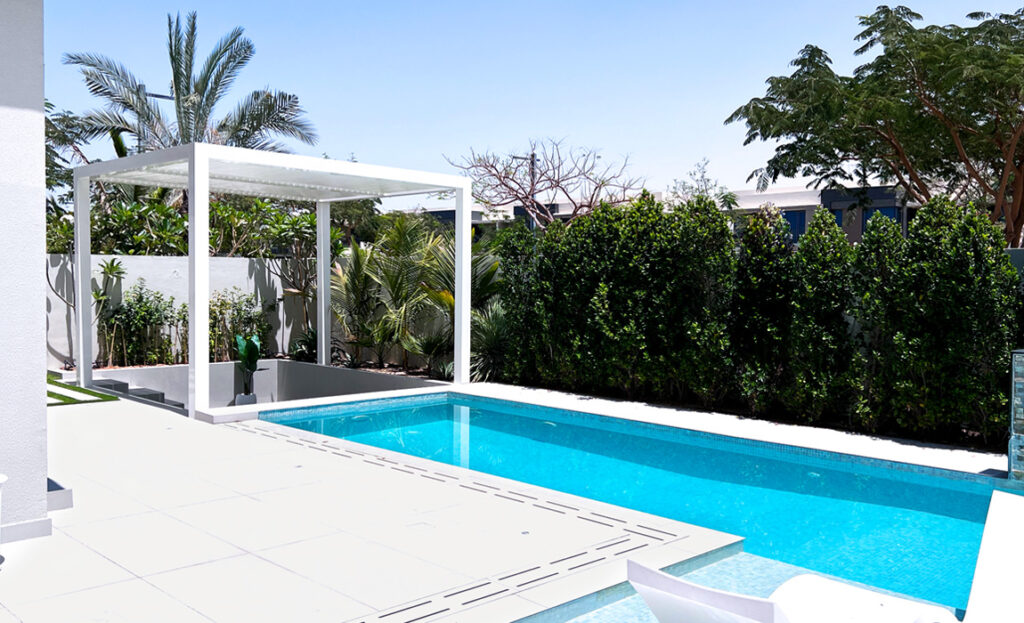
Some communities limit boundary hedges to about 1.8 metres, so check your rules first. A hedge also takes time to fill in. Buy larger plants if you want privacy this year rather than in two.
If the plot is small
4. Do one zone properly
On a compact plot, a small plunge pool with a hedge behind it and a pergola over one end uses the space better than a bit of everything. The garden in the photo below is built that way. Narrow side passages can take vertical green walls of philodendron or rhoeo, where there is shade, and jasmine or bougainvillea on a trellis where there is sun.
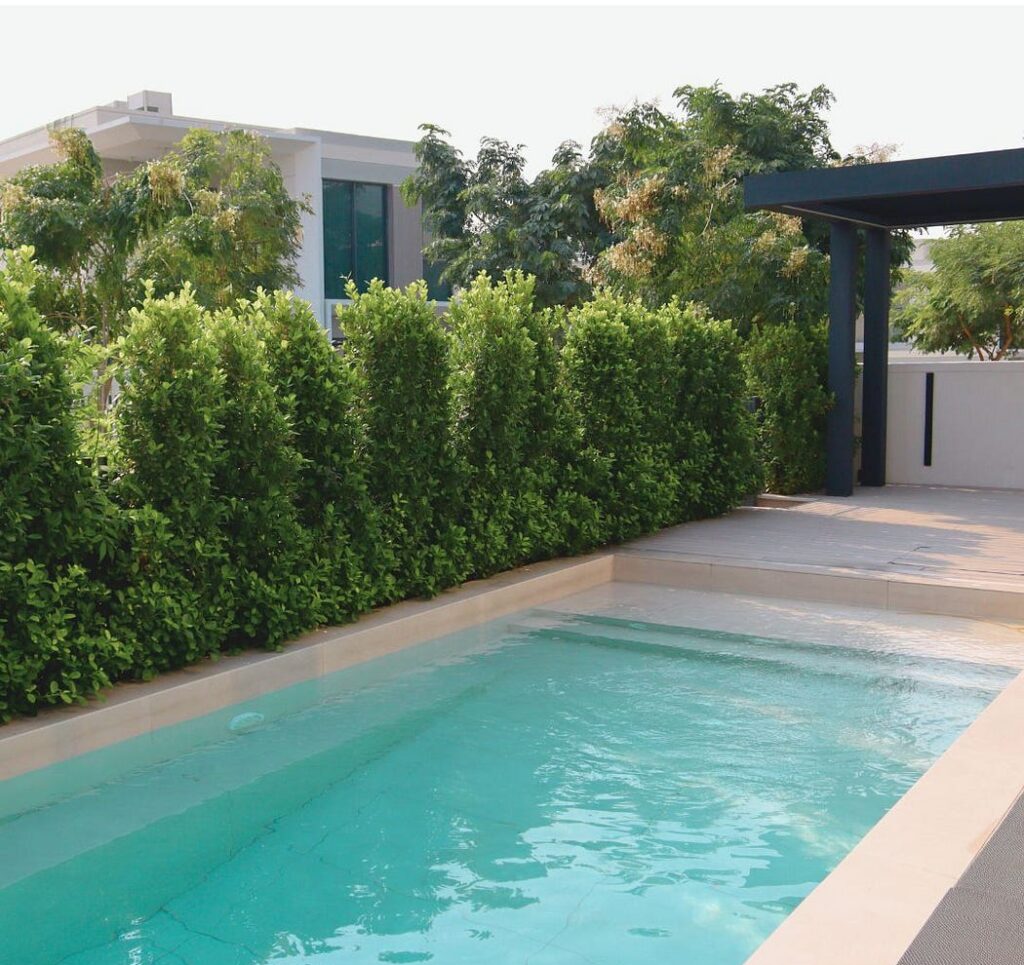
Be honest about what you give up. A pool and a pergola on a small plot usually leave no room for a lawn, so decide early whether the children’s play space or the swimming matters more.
If you have kids or pets
5. Keep a small lawn and pave or gravel the rest
Grass is the biggest water and upkeep item in a Dubai garden, so a smaller patch that gets used beats a large one that looks bleached by July. Property Finder’s guide to lawns in Dubai names Bermuda, Durban and Sea Isle as warm-weather grasses. Bermuda copes with partial shade but not full shade, Durban tolerates shade and salty irrigation water, and Sea Isle copes with infrequent watering.

Artificial grass is the other route. It needs almost no water and no mowing, but it costs more to lay and gets noticeably hotter than real grass in direct sun. Put it where a wall or pergola shades it for the afternoon. Whichever you choose, avoid oleander where children or pets play. It copes well with heat and salt air, but it is toxic if eaten.
Around the pool
6. Choose pool-side plants and surfaces together
Plants that suit a pool edge include traveller’s palm, sago palm, agave, aloe and frangipani, according to the same nursery guide. Frangipani handles Dubai heat and coastal air and should dry out between waterings. Group agave and aloe in odd numbers, and keep the spiky ones back from the water’s edge where people walk barefoot.

The surface matters as much as the planting. Slip-resistant natural stone or composite decking stays more comfortable underfoot in summer than smooth, dark paving. Decking around a pool needs the edge, drainage and levels checked first, and our decking contractors in Dubai page covers how we approach it.

For evenings
7. Light the garden in layers
Most gardens are used after sunset for half the year, and one bright floodlight makes them feel like a car park. Plan three layers instead: task lights on paths, steps and entrances, accent lights that uplight a tree or a wall, and softer ambient light from string lights, lanterns or LED strips. Solar path lights suit narrow side passages. Mains lighting needs cable routes planned before paving goes down, so decide on it at the design stage.
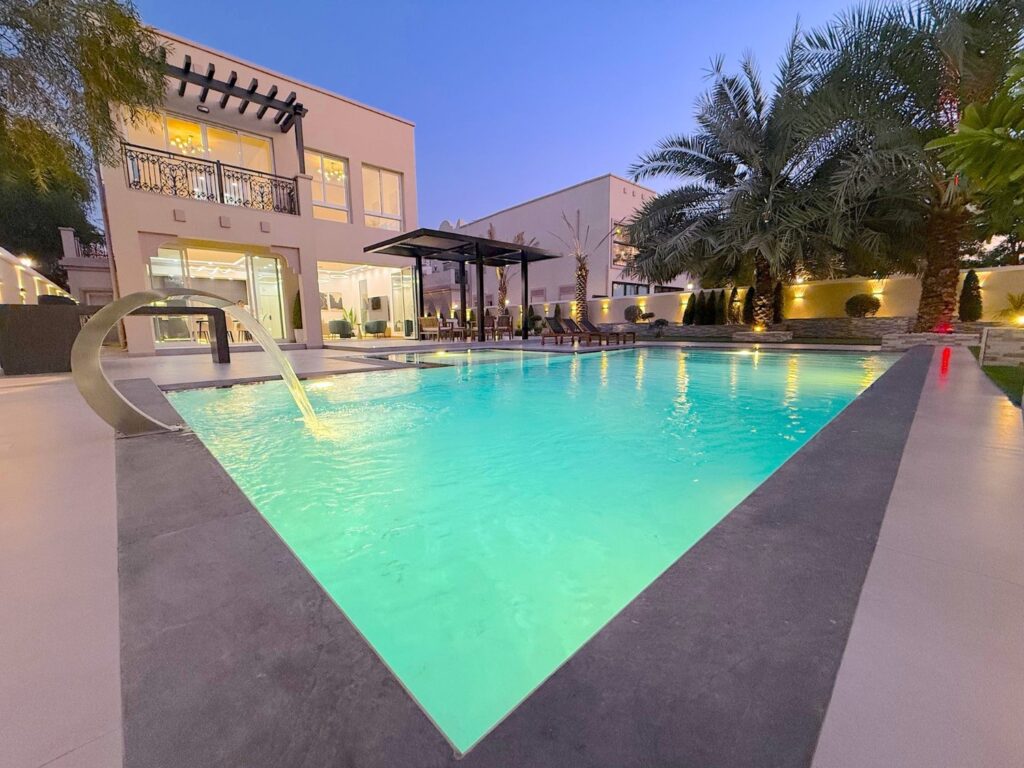
8. Build the kitchen and seating under the same roof
An outdoor kitchen works best under or beside the pergola, so cooking, bar seating and lounge sit in one shaded zone. Put the grill where smoke drifts away from the house and the seats. Gas, power and water lines need to be planned early, because they are costly to chase out of finished paving. A few herbs such as basil, mint and rosemary in raised planters keep the kitchen useful.
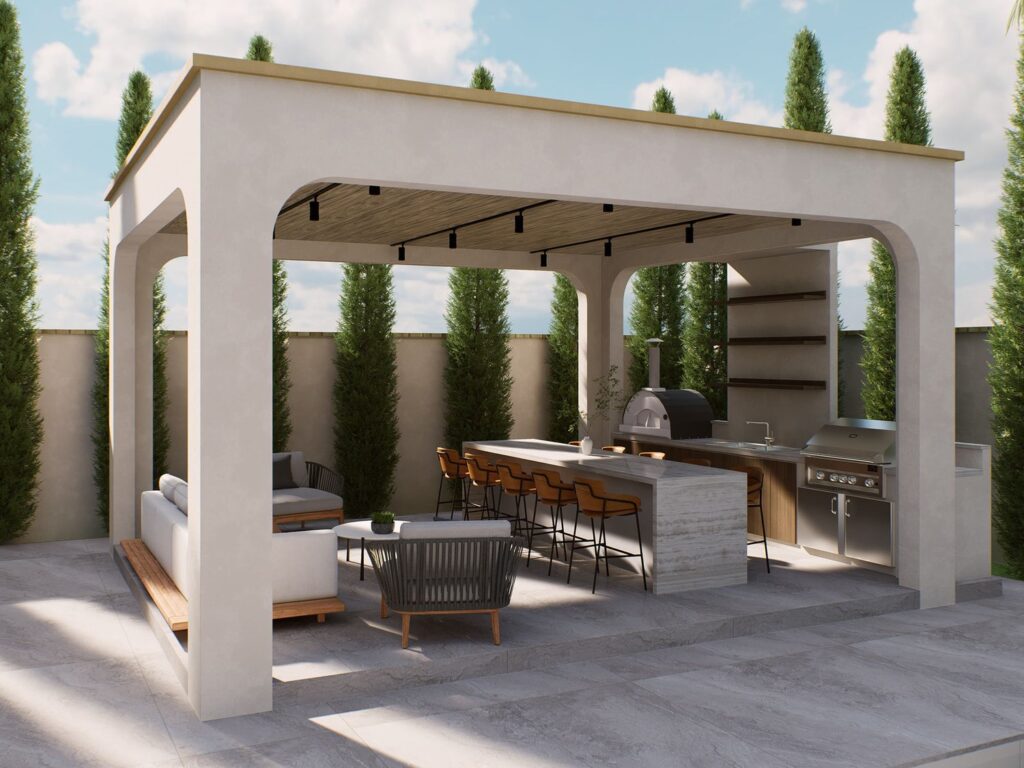
A sunken lounge is the alternative if you want seating without a built structure. See the layouts on our outdoor living spaces page.
For lower water use
9. Zone the drip irrigation and plant tough
Drip irrigation grouped into zones by plant water needs, on a timer, wastes far less than hand watering or sprinklers, and mulch around plant bases holds moisture. Watering usually needs to go up in April and May as the heat builds.
For planting, the same nursery’s heat-tolerant plant list includes olive (full sun, sharp drainage, a deep soak every week or two), bougainvillea (too much water reduces flowering), desert rose (overwatering is the main cause of loss) and date palm, including compact forms for smaller courtyards. Yellow trumpet flower (Tecoma stans) is described as sun-loving and drought tolerant.
Drought tolerant does not mean no water. New plants need regular watering until they are established, and a badly zoned system can waste more water than a lawn. The running costs, including water, are in our landscaping cost guide.
Questions owners ask
What are the best plants for a Dubai villa garden?
Ones that handle full sun and dry spells, such as olive, bougainvillea, frangipani, date palm, desert rose and ghaf. Check the sun and drainage needs of each, because most losses come from overwatering. Leave oleander out of play areas.
Is artificial grass better than natural grass in Dubai?
It depends on how the lawn is used. Artificial grass saves water and mowing but costs more to lay and gets hot in direct sun. Natural grass is cooler and cheaper to install, but it needs watering and care through summer.
How do I get privacy without building a higher wall?
Plant a hedge of ficus nitida, conocarpus or clumping bamboo along the boundary, and check whether your community caps hedge height. A pergola with side screens also blocks views into a seating area.
Do I need approval for a pergola or garden changes?
For pergolas, water features and boundary changes, usually yes, from both your master developer and the municipality. Rules differ between communities, so confirm yours before ordering anything.
Can I landscape the garden in stages?
Yes. Do irrigation, levels and paving first, since they are costly to redo, then add planting, lighting and shade as the budget allows.
If you have a plot in mind, tell us the community and roughly what you want to fix, and we will visit and suggest a layout. You can book a design consultation, see our landscape design and construction work, or call or WhatsApp +971 50 660 2296.
